Colour symbolism
The House of Bernarda AlbaIn The House of Bernarda Alba, Colour symbolism gives visible form to the play’s conflict between life-enhancing desire and the social order that confines it. Colours do not function as isolated emblems: they acquire force through contrast with the house’s walls, clothing, light, and recurring images of nature and money. White and black make confinement seem built into daily life, while green and red point toward vitality that the household cannot comfortably contain.
The House: White, Routine, and Confinement
The three settings share thick white walls: the inner room with arched doorways and rush-bottomed chairs, the second inner room with doors leading to the bedrooms, and the courtyard where the family eats. The repeated whiteness links the rooms into one enclosed domestic world. It suggests the daughters’ virginity, but also the monotonous and unchanging routine imposed on them; the repeated doorways and tolling bells reinforce that sameness. Before the characters appear, the stage picture has already established a life narrowed by the house.
That white setting is not an image of open possibility. Its visual continuity belongs to a home marked by oppressive silence, thick walls, and shut windows. The contrast between the house and the natural world gives colour its dramatic pressure: the daughters’ lives remain enclosed, while vitality is associated with forces that exist beyond the limits of domestic routine.
Black Clothing and the Growing Darkness
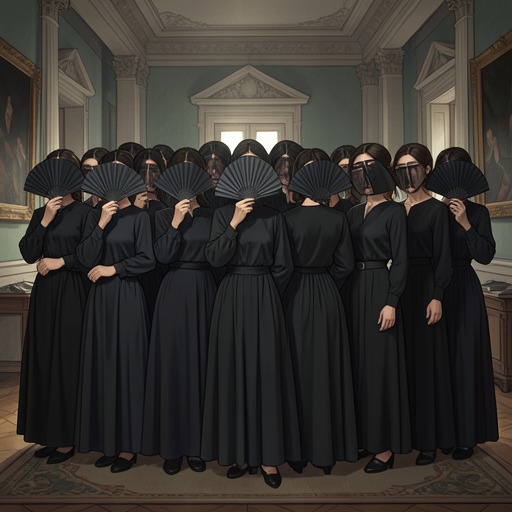
Bernarda wears black throughout the play, and her daughters are similarly dressed. Her clothing makes her the embodiment of a narrow-minded authority that stifles joy; the black also carries an association with the growing Fascism affecting Europe in the 1930s. For the daughters, the same dark dress code reflects the bleak future under their mother’s roof. The exception is Adela, whose youth and vitality set her apart from the family’s visual uniformity.
Black extends beyond clothing into the house’s lighting and the play’s progression. The windows are shuttered, and sunlight barely enters, leaving the rooms in a state of half-light. By the third act, the action increasingly takes place in night’s darkness, which reflects the emotional darkness in which several characters are trapped. After Adela’s suicide, darkness takes on its most final meaning for her and anticipates further mourning and confinement for her sisters; Martirio’s possible descent into madness is associated with the shadowy world represented by her grandmother.
Green and Red: Vitality Against Convention
Adela’s green dress is the clearest visual counterpoint to the household’s dark clothing. When she refuses confinement in the first act, she is wearing it; the colour links her with the vitality and fertility of nature. Green thus marks more than a difference in appearance: it places her on the side of instinct and life in the play’s conflict with convention and repression. Her contrast with her sisters makes their shared clothing seem like a sign of the future prescribed for them, rather than a neutral choice.
Other images extend this association beyond Adela. The olive grove, recurring in Lorca’s work as an image of nature’s vitality and fertility, is connected with Paca la Roseta and the young men who take her there. In the second act, Poncia describes one of the strong young harvesters as having green eyes. Green flowers also appear alongside red flowers on Adela’s fan, which Bernarda angrily rejects. Red, the traditional colour of passion, belongs to the same contrasting world as green: colour repeatedly signals what Bernarda’s discipline tries to contain, even as the plot brings that conflict to a tragic end.
Gold, Material Life, and the Play’s Wider Meaning
The play’s colours also connect private relationships to material circumstances. Angustias points to the value of her inheritance by contrasting gold in coffers with beauty. Gold, however, is not presented as a simple sign of prosperity. It is associated with Bernarda’s exploitation of workers for profit, the sisters’ envy and resentment over Angustias’s inheritance, and the family conflict caused by Prudencia’s husband and his brothers disputing money left to them. Its significance arises from these relationships: wealth shapes status and marriage, but it also intensifies bitterness and division.
Together, these colour associations support the play’s movement from a specific provincial household toward a wider human conflict. Lorca described the work as a documentary of village life, and its social world is grounded in contemporary Spanish attitudes toward women’s domestic role and obedience. Yet its visual contrasts reach beyond any single house: the white and black world of routine, authority, and enclosure opposes the green and red world of instinct and passion. Colour symbolism makes that opposition legible onstage without separating it from the economic and social structures that sustain it.